








If you're in your late 30s or 40s and noticing more hair in the shower drain, unexpected jawline breakouts, or skin that feels tight no matter what you put on it, you're far from alone. An estimated 50% of women experience noticeable hair thinning during the menopausal transition (Menopause, 2022). And roughly 25% of women in their 40s deal with acne they haven't seen since their teens (PMC, 2019).
These shifts aren't a reflection of poor habits. They're your body responding to real hormonal changes. And while that can feel frustrating, especially when the changes show up on your face and in your hairbrush, understanding what's driving them is the first step toward building a routine that works with what your body is going through. Not against it.
This article breaks down why perimenopause affects your hair and skin, which nutrients have the strongest research behind them, and when it's worth getting professional support.
Key Takeaways
|
Why perimenopause affects your hair and skin
Estrogen does far more than regulate your cycle. It's directly involved in maintaining skin thickness, collagen production, and hair follicle activity. Research shows that skin collagen content declines at an average rate of 2.1% per postmenopausal year, with up to 30% of total collagen lost in the first five years after menopause (PMC, 2013). That's a significant structural change happening beneath the surface.
Here's what's going on at the hormonal level. Estrogen supports collagen and elastin, the proteins responsible for skin firmness and bounce. It also promotes dermal hydration and helps keep hair in its active growth stage (anagen) for longer. As estrogen levels fluctuate and decline during perimenopause, these protective effects weaken.
At the same time, androgens like testosterone don't decline as sharply. This creates a relative androgen dominance. In genetically susceptible women, that shift can shrink hair follicles, leading to thinning at the crown and a wider part line, and ramp up oil production in the lower face and jawline, triggering breakouts. So what feels like separate problems, thinning hair and adult acne, often share the same root cause.
Worth noting: decades of sun exposure, nutrition patterns, stress, and sleep habits also shape how your skin and hair respond during this transition. Perimenopause doesn't happen in isolation from your broader health history.
What causes perimenopause hair loss, and what may help?
A cross-sectional study of 200 postmenopausal women found a 52.2% prevalence of female pattern hair loss (Menopause, 2022). Hair loss during perimenopause typically follows one of two clinical patterns, and understanding which one applies to you matters for how you approach it.
Chronic telogen effluvium (CTE)
In CTE, a higher-than-normal proportion of hair follicles shift into the resting (telogen) resting stage at once, causing diffuse shedding across the scalp. Triggers include hormonal fluctuations, iron deficiency, stress, and illness. The encouraging part? CTE-related shedding often stabilizes once the underlying trigger is addressed.
Female pattern hair loss (FPHL)
FPHL shows up as gradual thinning over the crown and central scalp, with a widening part. It's associated with androgen sensitivity in follicles and genetic predisposition. In white women, prevalence ranges from 3–12% in the 30s to 29–56% in women over 70 (PMC, 2023). FPHL tends to be progressive, but early intervention may help maintain density.
How do you know which pattern you're dealing with? A dermatologist can help distinguish between them. If your shedding is sudden or patchy, or accompanied by scalp symptoms, fatigue, or menstrual changes, a professional evaluation is especially important.
Nutrients that may support hair health
One study found that 70% of female alopecia cases were iron-deficiency related (PMC, 2023), making nutrient status one of the most actionable factors you can address. No single nutrient is a guaranteed fix, but correcting documented deficiencies can make a meaningful difference.
Iron
Iron deficiency is one of the most common and underdiagnosed contributors to hair shedding in women. Research suggests that optimal hair growth is observed when serum ferritin reaches around 70 ng/mL (PMC, 2022), well above the standard "normal" cutoff many labs use. If you're experiencing heavy periods alongside hair thinning, testing ferritin is a worthwhile first step. Supplementation should always happen under medical supervision, as too much iron carries its own risks.
Vitamin D
A meta-analysis found that 50.38% of women with female pattern hair loss had vitamin D deficiency (Frontiers in Nutrition, 2024). While we can't say for certain that correcting the deficiency reverses hair loss, ensuring adequate vitamin D intake supports overall health and may be one piece of a broader hair-health strategy. Many women in northern climates or with limited sun exposure fall short without supplementation.
Zinc and biotin
Zinc deficiency may contribute to both hair loss and skin changes. But a large cross-sectional study found only small differences in zinc levels between those with and without hair loss, suggesting correcting a true deficiency matters more than blanket high-dose supplementation. Biotin deficiency can cause hair shedding and brittle nails, but in women with normal biotin levels, evidence for additional supplementation is limited. Testing first makes sense.
Protein
Hair is made primarily of keratin, a structural protein. In a randomized, placebo-controlled trial, a multi-ingredient oral supplement containing marine proteins, vitamins, and minerals improved hair volume and scalp coverage in women with thinning hair (Dermatol Res Pract, 2015). Because the supplement included multiple active components, no single ingredient gets all the credit, but adequate protein intake is foundational to hair health.
How perimenopause changes your skin, and what may help
A 2025 narrative review in the Journal of Cosmetic Dermatology confirmed that menopause accelerates skin aging through estrogen loss, with measurable declines in collagen, elasticity, and hydration (Viscomi et al., 2025). You might notice your go-to moisturizer isn't cutting it anymore, or that your skin feels drier and thinner than it used to. These aren't cosmetic complaints. They reflect real structural changes.
Dryness and loss of elasticity
As estrogen declines, skin thickness drops by roughly 1.13% per postmenopausal year (PMC, 2013). Your skin barrier, the outermost layer that locks in moisture and keeps irritants out, relies on a balance of fatty acids to function well. This is partly why omega-3 and omega-6 intake become more relevant during perimenopause, and why what you eat can show up on your skin.
Hormonal acne and breakouts
Breakouts in your 40s can feel backwards. But roughly 25% of women ages 40–49 experience acne (PMC, 2019), tied to the same androgen shift behind hair thinning. Breakouts typically cluster along the jawline, chin, and neck, areas with high androgen sensitivity. Triggers go beyond hormones, too: certain cosmetics, hair products, mask friction, and some medications can make things worse. Because adult acne has multiple drivers, dermatologists often recommend a combination approach.
Nutrients that may support skin health
A 2025 meta-analysis of 23 randomized controlled trials with 1,474 participants found that collagen supplements significantly improved skin hydration, elasticity, and wrinkle depth (PubMed, 2025). Nutrition plays a meaningful supporting role alongside topical care.
Omega-3 fatty acids
Essential fatty acid deficiency may contribute to rough, scaly skin and dermatitis. In a small trial of a multi-ingredient formula containing omega-3s in women aged 40–60, participants experienced improvements in skin elasticity. Ensuring consistent omega-3 intake from fatty fish or targeted nourishment may support your skin barrier from the inside.
Vitamin C
Your body can't synthesize collagen without vitamin C. Inadequate intake directly impairs collagen production and skin integrity. During a life stage where collagen is already declining, ensuring consistent vitamin C through diet or a quality multivitamin is especially important.
Collagen peptides
Randomized trials have shown that low-molecular-weight collagen peptides may improve skin hydration by up to 23% and skin elasticity by 8.52% over six months in menopausal women (MDPI, 2024). While formulations vary, the growing body of evidence positions collagen as a potentially supportive protein source for skin during this transition.
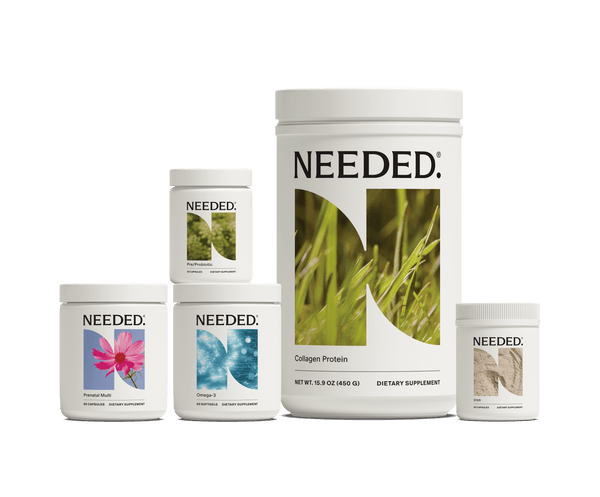
Needed's Collagen Protein is grass-fed and sustainably sourced to support your nourishment through perimenopause and beyond.
And don't overlook the basics. Consistent hydration, gentle cleansing, avoiding overly hot water, and daily broad-spectrum sunscreen work in your favor every single day.
Which nutrients support both hair and skin?
Several nutrients sit at the crossroads of perimenopause, hair loss and skin changes. If you're going to focus your efforts somewhere, these pull double duty.
|
Nutrient |
Hair benefit |
Skin benefit |
Key evidence |
|
Iron |
May support follicle recovery when deficiency is corrected |
Supports cellular energy and tissue repair |
70% of female alopecia cases linked to iron deficiency |
|
Vitamin D3 |
50% of FPHL patients are deficient |
Supports immune function and skin cell turnover |
Meta-analysis across non-scarring alopecias |
|
Omega-3s |
Anti-inflammatory support for follicles |
May improve skin elasticity and barrier function |
Trial showed elasticity gains in women 40–60 |
|
Biotin + zinc |
Correcting deficiency may improve shedding |
Deficiency linked to dermatitis |
Benefits strongest when true deficiency is present |
|
Collagen peptides |
Some reports of nail and hair improvement |
23% hydration improvement in 6-month trial |
Meta-analysis of 23 RCTs supports skin outcomes |
Targeted nourishment works best when it's informed by testing. Checking your levels first, especially for iron, vitamin D, and zinc, helps you avoid spending on nutrients you don't need more of. Needed's perimenopause collection is formulated for the specific nutritional demands of this life stage, with bioavailable forms your body can absorb and use.
Lifestyle habits that make a real difference
A clinical study found that poor-quality sleepers scored 4.4 on the SCINEXA skin aging scale versus 2.2 for good sleepers and showed 30% slower skin barrier recovery after environmental stress (Oyetakin-White et al., 2015). Day-to-day habits don't get the same attention as nourishment, but they often matter more in the long run.
Sleep
Deep sleep is when your body handles tissue repair and cellular renewal, including in skin and hair follicles. Chronic poor sleep accelerates visible skin aging. Aiming for a consistent sleep schedule and a calming wind-down routine isn't only about energy. It directly supports how your skin recovers.
Stress management
Cortisol, the primary stress hormone, can push hair follicles into their resting stage prematurely and trigger inflammatory skin responses. Chronic stress is commonly reported as a trigger for both shedding and breakouts. Walking, yoga, breathwork, journaling, therapy: the specific practice matters less than consistency.
Movement
Regular physical activity supports circulation, delivering nutrients to hair follicles and skin cells. Exercise also helps regulate stress and improve sleep quality, two factors that directly affect hair and skin during perimenopause. You don't need an intense routine. Consistent, moderate movement, like walking, strength training, or yoga, tends to be the most sustainable approach.
Sun protection
UV exposure accelerates collagen breakdown and pigment changes. During a life stage when collagen is already declining, daily broad-spectrum sunscreen, hats, and shade-seeking habits become even more powerful protective tools.
Gentle hair and skincare
Avoiding harsh scrubs, very hot styling tools, tight hairstyles, and stripping cleansers protects both the hair shaft and the skin barrier. Small, consistent habits here often make more of a difference over months than any single product switch.
Frequently asked questions
Is perimenopause hair loss reversible?
It depends on the type. Shedding related to chronic telogen effluvium, triggered by hormonal shifts, iron deficiency, or stress, often improves once the underlying cause is addressed. Female pattern hair loss tends to be progressive, but early intervention with medical, nutritional, and cosmetic strategies may help maintain density. A dermatologist can clarify which pattern applies to you.
Why am I getting acne in my 40s?
Roughly 25% of women in their 40s experience acne, even without a history of breakouts (PMC, 2019). As estrogen declines, androgens become relatively more dominant, increasing oil production in the jawline, chin, and neck. Stress, certain products, mask friction, and medications can add to the picture. A dermatologist experienced with hormonal acne can help you find an approach that works for your skin and your life stage.
Does collagen help with perimenopause skin?
A meta-analysis of 23 randomized controlled trials found that collagen supplements significantly improved skin hydration, elasticity, and wrinkle depth (PubMed, 2025). Formulations vary, so collagen is best viewed as a supportive protein source with growing evidence rather than a guaranteed solution.
Needed's Collagen Protein is formulated with grass-fed, sustainably sourced collagen to support your nourishment through perimenopause and beyond.
When should I see a doctor about hair or skin changes?
Seek professional input if hair loss is sudden, patchy, or accompanied by scalp symptoms, fatigue, weight changes, or menstrual irregularities. For persistent acne, a provider who understands hormonal drivers can offer targeted treatments. A trusted healthcare practitioner can help personalize your approach based on what your body needs right now.
The bottom line
Changes to your hair and skin during perimenopause can feel especially personal. They're visible, they're hard to ignore, and they can affect how you feel walking out the door. But they're also your body responding predictably to a real hormonal shift, not a failure of effort or routine.
Understanding the underlying mechanisms gives you real options. Addressing nutrient gaps, building consistent daily habits, and working with providers who understand this life stage can meaningfully change how your hair and skin look and feel. You don't need to overhaul everything at once. Start with one or two changes, stay consistent, and adjust from there.
Perimenopause changes what your body needs. Needed's perimenopause collection is formulated to support you through it.


