

Choosing a prenatal can be overwhelming. With hundreds of options on the market, it’s hard to know where to start. Every brand claims to be the one you need. But there’s no standard for what’s actually in a prenatal–it’s up to the brand to choose. And nutrient levels vary significantly from brand to brand.
So we did the work for you. We pulled the labels from three of the most talked-about prenatal vitamin brands — including our own — and compared them, nutrient by nutrient, against the Recommended Dietary Allowances (RDAs) for pregnancy, or against the Adequate Intakes (AIs) for nutrients without an RDA.
The RDA is a floor, not a target
Here's what's worth knowing before you buy: the RDA itself is a floor, not an optimal target for pregnancy, and a lot of prenatal vitamins on the market don't even reach that floor.
The national nutrition standards, including the RDAs, that underpin prenatal nutrition guidance, supplement formulation, policies, and clinical care in the US were established in 1941 — born out of a bare-minimum philosophy as our country emerged from the Great Depression and prepared for war.
Though these standards have been updated since 1941, of the nearly one million people whose data shapes today’s pregnant and breastfeeding standards, fewer than 5% are pregnant or breastfeeding. Further, morbidities of pregnancy and breastfeeding were not considered when setting these guidelines. Women’s needs were never centered as part of RDAs, and 85 years later, they still aren’t.
Most women aren't even meeting the nutritional floor
Even judged against the bare minimum bar of RDAs, most pregnant women fall short — both from diet and from supplementation.
Choline is one of the starkest examples of that mismatch. The NIH Office of Dietary Supplements notes that 90–95% of pregnant women consume less choline than the established Adequate Intake (AI). Although the evidence supporting choline’s importance during pregnancy has grown substantially, federal dietary reference guidelines have not yet advanced from an AI to a formal RDA. Typical prenatal supplements contain minimal or no Choline at all, which is a large part of why supplementation doesn't fully close the gap. Choline is directly tied to fetal brain and spinal cord development, which makes that shortfall more than a technicality.
Separately, a 2024 analysis in JAMA Network Open, using national NHANES data from 1999 to 2018, found that inadequate intake among pregnant women has been getting worse, not better, over two decades for nutrients including Vitamin A, Vitamin C, and Iron.
Put together, this is the real story behind many prenatal multivitamins: the label says "prenatal," but for a large share of products on the shelf, the actual formulation was never built to close the gap between what a pregnant body needs to thrive and what an average diet provides.
Not all prenatals are built the same
To see this concretely, we compared the labeled daily amounts in Needed's Prenatal Multi Pro, Needed's Prenatal Multi, and Needed's Prenatal Multi Gummy against two widely used competitors — Ritual's Prenatal Multivitamin and Perelel's Trimester Packs (1st, 2nd, and 3rd) — using the pregnancy RDA or AI for each nutrient as the reference point.
Iron is included in the reference chart against the pregnancy RDA (27 mg) but is intentionally left out of Needed's multivitamins, as we explain later in the article. Omega-3 fatty acids (DHA and EPA) have no established RDA or AI, despite substantial evidence for their role in fetal brain and eye development*, so they don't appear in the chart above.
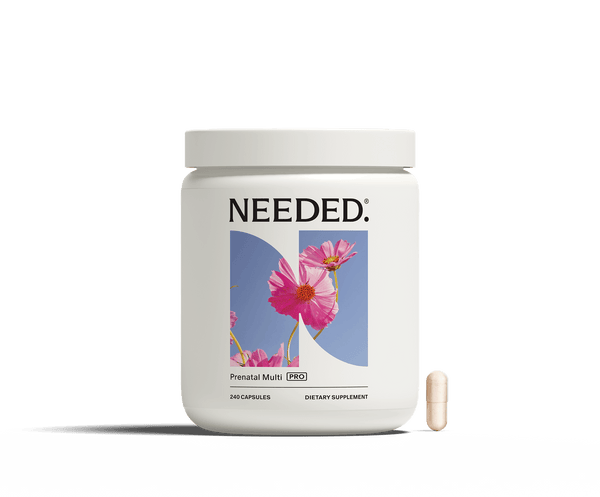
Averaged across every nutrient with an established pregnancy RDA, Needed's Prenatal Multi Pro is dosed roughly 12x higher than Ritual's Prenatal Multivitamin†, and 5–9x higher than Perelel's Trimester Packs†, depending on the trimester. Needed's Prenatal Multi averages 7x higher than Ritual† and 3–6x higher than Perelel's Trimester Packs†. Even Needed's Prenatal Multi Gummy averages 4x higher than Ritual† and 2–3x higher than Perelel's Trimester Packs†, and out-doses Perelel's Trimester Packs on 11 individual vitamins and minerals.
Ritual's formulation contains no Vitamin A, no Vitamin C, no Thiamin, no Riboflavin, no Niacin, no Vitamin B6, no Zinc, and no Selenium. Not a low dose, but none at all. Perelel's Trimester Packs contain no Biotin, no Manganese, and no Molybdenum across all three trimesters. These aren't obscure micronutrients: zinc and selenium support immune function and thyroid health, and the missing B-vitamins like Thiamin, Riboflavin, and Niacin are essential for energy metabolism*. A prenatal missing them isn't a lighter version of a multivitamin — it's missing some of the reasons to take one.
Calcium is a nutrient that we include in our Prenatal Multi Pro, but leave out of our Prenatal Multi (3 capsules) and Prenatal Multi Gummy. While Calcium is critical during pregnancy, it is also a nutrient that can be more readily obtained in meaningful amounts through food. For women who need additional Calcium supplementation, meaningful doses take up a significant amount of space—making Calcium difficult to include in lower-capsule-count or gummy formats without displacing other nutrients that can be harder to obtain adequately from diet alone. Needed’s Prenatals are formulated to include supporting nutrients that help with Calcium absorption, including clinically studied dosing of Vitamin D3, and optimal amounts of Vitamin K2.
Folate is one of only 2 nutrients with an established RDA/AI that Needed doses lower than Ritual and Perelel. More isn’t necessarily better when it comes to Folate. Unlike many nutrients that remain broadly underconsumed during pregnancy, Folate exposure has changed dramatically since mandatory food fortification: women now receive Folate from food, fortified foods, and supplements simultaneously. Emerging research suggests the relationship between Folate exposure and health may be non-linear, making both total intake and Folate form important considerations. Needed’s Prenatal Multis are formulated with the Methylfolate form for optimal absorption, and dosed to provide sufficient Folate for meaningful pregnancy support while accounting for the Folate women are likely to consume through their diets.
What we chose to leave out, and why
Two common pregnancy nutrients are excluded from Needed's prenatal vitamins, and both are deliberate choices rather than oversights.
Iron has an established pregnancy RDA of 27 mg, but individual need varies enormously based on diet and existing iron status — too much iron can cause GI distress and, over time, contribute to oxidative stress, while too little leaves a woman anemic. Rather than locking a fixed amount into the multivitamin, Needed offers iron as a separate, adjustable supplement so a woman and her healthcare provider can dose it to her actual bloodwork rather than a one-size-fits-all average.
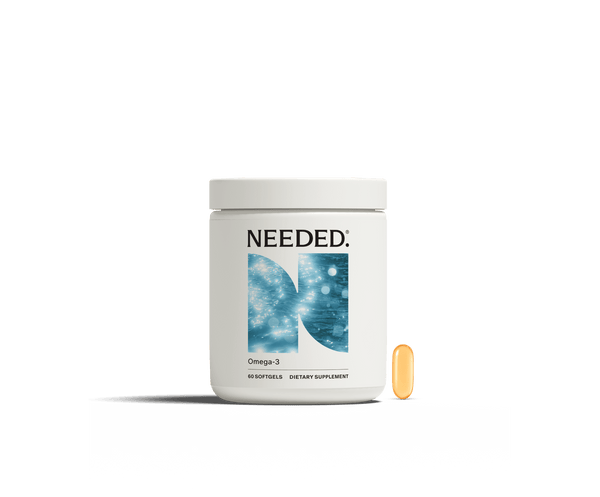
Needed offers a standalone Omega-3 providing 500 mg of DHA and 500 mg of EPA per serving — a dose set apart from the multivitamin because oil-based nutrients like DHA and EPA take up far more capsule volume than compressed vitamin and mineral powders. There wasn't a way to fit a meaningful dose into the multi itself, so Needed built it as its own product instead. That compares to 250 mg DHA and 125 mg EPA in Perelel's Trimester Packs and 350 mg DHA with no EPA in Ritual's Prenatal Multivitamin.
The takeaway
The RDA was never built to be an optimal nutrition target for pregnancy — it's a floor, built from research that largely excluded pregnant women in the first place. Many popular prenatals fall short of even this bare minimum level.
We believe the most reliable way to evaluate a prenatal is to compare its nutrient panel directly against pregnancy RDAs rather than rely on the word "prenatal" on the label. That comparison is the Radically Better Nutrition standard that Needed's prenatal vitamins are formulated to meet.
Sources: labeled serving amounts compared to pregnancy RDAs/AIs, calculated as an average across nutrients with an established RDA. Crawford et al., "Micronutrient Gaps and Supplement Use in a Diverse Cohort of Pregnant Women," Nutrients 15(14):3228 (2023). JAMA Network Open (October 2024), NHANES 1999–2018 analysis of nutrient adequacy among pregnant and non-pregnant women. NIH Office of Dietary Supplements, Choline and Folate Health Professional Fact Sheets. Commonwealth Fund, 2025 international comparison of maternal mortality.
*These statements have not been evaluated by the Food and Drug Administration. These products are not intended to diagnose, treat, cure, or prevent any disease.
†Based on a comparison of each brand’s labeled daily serving amounts of vitamins and minerals relative to the pregnancy Recommended Dietary Allowances (RDAs), calculated as an average across those nutrients. As of December 2025.


