







Protein has become one of the most talked-about topics in nutrition. From plant-based powders to high-protein snacks, it seems to be everywhere. But while social media is full of advice on "meeting your protein needs," many women are still unsure how much they actually need or whether they're getting enough. This guide breaks down the current recommendations, including how protein needs shift during key life stages like pregnancy and perimenopause.
What Is the Recommended Daily Protein Intake for Women?
The Recommended Dietary Allowance (RDA) for protein is:
- 0.8 grams per kilogram of body weight per day, or
- roughly 0.36 grams per pound
For most adult women, this works out to about 46 grams per day.1
However, the RDA is a baseline, not a target. As Harvard Health puts it, "it's the minimum amount you need to keep from getting sick," not the specific amount you should eat every day.2 The RDA is set to cover the basic needs of nearly all healthy people. It isn't designed to account for goals like building or keeping muscle as you age.
The newest Dietary Guidelines for Americans (2025–2030) reflect this, suggesting that adults aim for 1.2–1.6 grams of protein per kilogram of body weight per day.3
How to Calculate Your Own Protein Needs
To find your RDA, multiply your weight in pounds by 0.36.
For example:
- A 140-pound woman: 140 × 0.36 = about 50 grams of protein per day (RDA baseline)
For a more personalized estimate based on your age, height, weight, activity level, and life stage, try the USDA's DRI Calculator for Healthcare Professionals.4
Pregnancy: More Protein, for Obvious Reasons
When you're growing a human, protein needs go up substantially. The National Academy of Medicine (formerly the Institute of Medicine) recommends that pregnant women get 71 grams of protein per day (or 1.1 g/kg). That's about 25 grams more than before pregnancy, and the extra protein is needed mainly in the second and third trimesters, when growth is fastest.1 Newer research suggests needs may be even higher, especially in late pregnancy.5
That protein supports everything from your baby's development to the growth of your own tissues: the placenta, uterus, blood supply, and breast tissue.
If that number feels high, remember:6
- 3 oz cooked chicken breast = ~26 g
- 6 oz (¾ cup) plain Greek yogurt = ~17 g
- 1 large egg = ~6 g
- ½ cup cooked lentils = ~9 g
Spreading protein across your meals and snacks gets you there quickly.
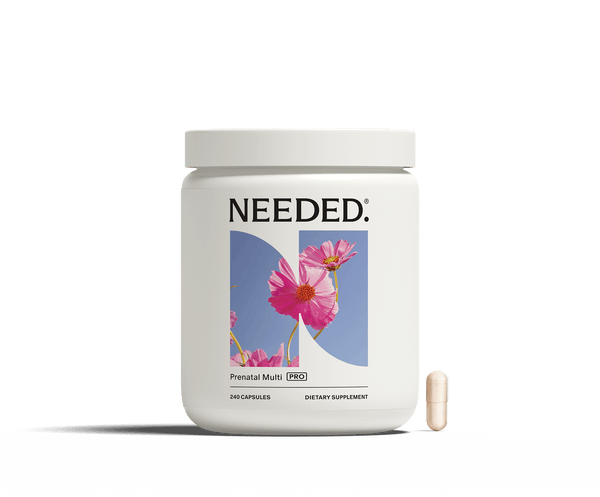
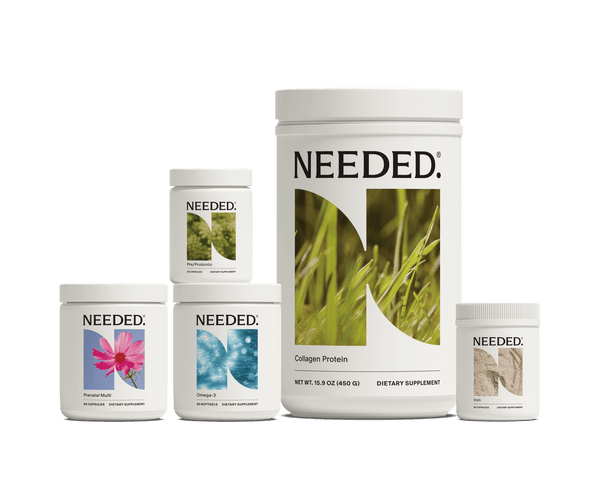
You can also add collagen, like Needed's Prenatal Collagen Protein, to help meet your protein needs during pregnancy. Keep in mind that collagen isn't a complete protein (it lacks the essential amino acid tryptophan),7 so it should complement other protein foods, not replace them.
Perimenopause: When Muscle Loss and Metabolism Hit Differently
During perimenopause and early menopause, estrogen levels decline, and with that can come a loss of muscle mass, an increase in body fat, and changes in insulin sensitivity.8 Protein plays a key role in helping your body adapt.
While the official RDA stays the same (0.8 g/kg/day), the new Dietary Guidelines suggest 1.2–1.6 g/kg/day,3 and many nutrition and sports medicine experts recommend at least 1.0–1.2 g/kg/day for aging adults and more for those who exercise regularly.9,10 For many women in their 40s and 50s, 1.2–1.5 g/kg works out to roughly 80–100 grams per day.
Getting enough protein helps preserve lean mass, supports strength, and can help you feel full, all of which become harder to protect with age.11 Protein works best when paired with strength training. Together, they build and maintain muscle more effectively than either one alone.12
Special Considerations for GLP-1 Medications (Ozempic, Wegovy, Mounjaro): Smaller Meals, Higher Stakes
If you're taking a GLP-1 medication for diabetes or weight management, your appetite may drop and your stomach may empty more slowly. That can make it hard to meet your nutrient needs, especially for protein.
Why that matters:
- You may be losing weight quickly.
- That weight loss can include muscle, not just fat. In one major trial, lean mass made up roughly 40% of the weight lost.13
- Nausea or fullness might lead you to skip protein-rich meals without meaning to.
Experts recommend making adequate protein and regular strength training a priority during GLP-1 treatment to help preserve muscle.14 In practice, that means including high-quality protein at every small meal and snack. Many women will want to aim for the higher range discussed above rather than the RDA minimum. A registered dietitian can help you find the right target.
If you're planning a pregnancy, talk with your practitioner about when to stop your GLP-1.
But It's Not Just About Protein: Fiber Matters, Too
As we dial up protein, we can't forget fiber, a nutrient most women don't get enough of. In fact, only about 5% of Americans meet the recommended intake.15
The recommended daily intake (Adequate Intake) of fiber is:1
- 25 grams per day for women ages 19–50
- 21 grams per day for women 51 and older
- 28 grams per day during pregnancy
Fiber is essential for:
- Supporting gut health and regular digestion
- Regulating blood sugar
- Promoting fullness and a healthy weight
- Supporting healthy estrogen levels: fiber may help your body clear excess estrogen through your gut16
Fiber is especially important during times of hormonal change, like pregnancy, when digestion can slow and constipation becomes more common.
Good sources include:6
- Lentils (~8 g per ½ cup cooked)
- Chia seeds (~8 g per 2 tbsp)
- Raspberries (~8 g per cup)
- Oats (~4 g per 1 cup cooked)
Adding more fiber while increasing protein, especially from plant sources like beans and lentils that provide both, creates a more balanced, sustainable way to feel nourished and energized.
What a Day of 75–100 Grams of Protein Actually Looks Like
You don't need to eat a steak at every meal. Here's a realistic day:6
|
Food |
Protein (g) |
|
2 eggs |
12 |
|
1 slice whole grain toast with nut butter |
7–8 |
|
6 oz plain Greek yogurt |
17 |
|
3 oz cooked salmon |
22 |
|
½ cup cooked lentils |
9 |
|
¼ cup almonds |
7 |
|
Total |
~75 |
Add a protein-rich smoothie or another small snack, and you can easily reach 90–100 grams without overhauling your diet.
Bottom Line
- The RDA for protein is about 46 g/day for women and 71 g/day during pregnancy. That's a baseline to meet basic needs, not an optimal target.
- In perimenopause, and for women using GLP-1 medications, aiming for a higher intake (around 1.2–1.5 g/kg/day, or roughly 80–100 g/day for many women) along with strength training may help preserve muscle and support metabolism.
- Don't overlook fiber. It's critical for gut health, blood sugar, and more, and most women don't get enough.
You don't need to obsess over macros, but you do deserve to feel clear, steady, and strong in your body. And for that, a little extra protein (and fiber) might go a long way.
Sources
- Institute of Medicine. Dietary Reference Intakes for Energy, Carbohydrate, Fiber, Fat, Fatty Acids, Cholesterol, Protein, and Amino Acids. National Academies Press; 2005. doi:10.17226/10490
- Harvard Health Publishing. How much protein do you need every day? Updated June 22, 2023. Accessed November 13, 2026.
- US Department of Agriculture, US Department of Health and Human Services. Dietary Guidelines for Americans, 2025–2030. January 2026.
- US Department of Agriculture, National Agricultural Library. DRI calculator for healthcare professionals. Accessed November 13, 2026.
- Stephens TV, Payne M, Ball RO, Pencharz PB, Elango R. Protein requirements of healthy pregnant women during early and late gestation are higher than current recommendations. J Nutr. 2015;145(1):73-78. doi:10.3945/jn.114.198622
- US Department of Agriculture, Agricultural Research Service. FoodData Central. Accessed November 13, 2026.
- Paul C, Leser S, Oesser S. Significant amounts of functional collagen peptides can be incorporated in the diet while maintaining indispensable amino acid balance. Nutrients. 2019;11(5):1079. doi:10.3390/nu11051079
- Greendale GA, Sternfeld B, Huang M, et al. Changes in body composition and weight during the menopause transition. JCI Insight. 2019;4(5):e124865. doi:10.1172/jci.insight.124865
- Bauer J, Biolo G, Cederholm T, et al. Evidence-based recommendations for optimal dietary protein intake in older people: a position paper from the PROT-AGE Study Group. J Am Med Dir Assoc. 2013;14(8):542-559. doi:10.1016/j.jamda.2013.05.021
- Jäger R, Kerksick CM, Campbell BI, et al. International Society of Sports Nutrition position stand: protein and exercise. J Int Soc Sports Nutr. 2017;14:20. doi:10.1186/s12970-017-0177-8
- Nair KS. Aging muscle. Am J Clin Nutr. 2005;81(5):953-963. doi:10.1093/ajcn/81.5.953
- Morton RW, Murphy KT, McKellar SR, et al. A systematic review, meta-analysis and meta-regression of the effect of protein supplementation on resistance training-induced gains in muscle mass and strength in healthy adults. Br J Sports Med. 2018;52(6):376-384. doi:10.1136/bjsports-2017-097608
- Wilding JPH, Batterham RL, Calanna S, et al. Once-weekly semaglutide in adults with overweight or obesity. N Engl J Med. 2021;384(11):989-1002. doi:10.1056/NEJMoa2032183
- Mozaffarian D, Agarwal M, Aggarwal M, et al. Nutritional priorities to support GLP-1 therapy for obesity: a joint advisory from the American College of Lifestyle Medicine, the American Society for Nutrition, the Obesity Medicine Association, and The Obesity Society. Am J Clin Nutr. 2025. PMID: 40450457
- Quagliani D, Felt-Gunderson P. Closing America's fiber intake gap: communication strategies from a Food and Fiber Summit. Am J Lifestyle Med. 2017;11(1):80-85. doi:10.1177/1559827615588079
- Rose DP, Goldman M, Connolly JM, Strong LE. High-fiber diet reduces serum estrogen concentrations in premenopausal women. Am J Clin Nutr. 1991;54(3):520-525. doi:10.1093/ajcn/54.3.520


